


Key Takeaways:
- What Materials Are Used to Make Concrete Blocks?
To understand how concrete blocks are made, it’s essential to first look at the materials involved in their production. These blocks are crafted from a carefully measured blend of cement, sand, gravel, and water. Depending on the desired performance, manufacturers may also incorporate admixtures to enhance strength or pigments to add colour.
- How Does the Concrete Block Manufacturing Process Work?
Modern concrete block factories rely on advanced automation to produce thousands of blocks per hour. Despite these technological upgrades, the core manufacturing process still follows four essential stages.
Introduction
Known as concrete masonry units (CMUs) in the construction industry, concrete blocks are precast building materials valued for their strength, durability, and versatility. Serving as a fundamental component in modern construction, these blocks are widely used for building load-bearing walls, partition systems, and for façade treatments.
But how are concrete blocks made, exactly? Read on to discover the full manufacturing journey, from raw materials to finished block.
How Are Concrete Blocks Made?
Concrete blocks are made from a precise mix of cement, sand, gravel, and water. Depending on performance needs, manufacturers may also add admixtures for strength or pigments for colour. The resulting blocks are classified as precast, meaning they are manufactured off-site and cured before arriving at your job site.
What is the Block Production Process?
Today’s concrete block factories in Singapore use highly automated systems to produce thousands of blocks per hour. While the technology has advanced, the core process still revolves around four critical stages:
1. Mixing
The first step involves measuring and combining raw materials—cement, sand, and gravel. Water, colour pigments, and chemical admixtures are then added to create a consistent mix.
The mixture must be stiff and dry enough to retain its shape during moulding. Too much moisture and the block won’t form properly; too little, and it could crumble.
2. Moulding
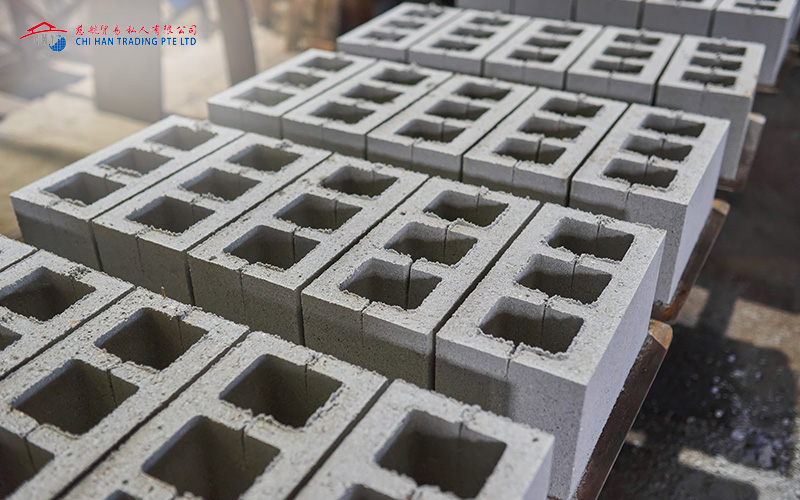
The dry concrete mix is fed into steel moulds that shape each block. Compression and vibration are applied simultaneously, compacting the mixture into dense, uniform forms. Moulds can be standard or custom, depending on block type and end-use. Once formed, the blocks are ejected onto steel pallets for the next phase.
3. Curing
This is one of the most critical phases. Curing strengthens the blocks and determines their long-term performance. There are two curing methods for concrete blocks:
- Low-pressure Steam Curing
Blocks are stored in chambers and exposed to controlled heat and moisture for 24 hours.
- High-pressure Autoclaving
A faster option that uses pressurised steam to harden blocks in 5 to 10 hours.
Proper curing maximises compressive strength, durability, and resistance to weather or chemicals. These properties are essential for projects in Singapore’s humid climate.
4. Cubing
Once cured, the blocks are stacked into bundles or cubes for handling, storage, or delivery. If the blocks are decorative—such as split-face or glazed finishes—these treatments are applied before final packaging.
What are the Types of Concrete Blocks Available?
After understanding how concrete blocks are made, we will now take a look at a variety of options tailored to different structural and architectural needs:
1. Standard Concrete Blocks
Ideal for load-bearing walls and foundations.
2. Lightweight Blocks
Made using pumice, expanded shale, or slag. They are ideal for reducing structural weight.
3. Cinder Blocks
They are produced using coal cinders—best used in non-structural walls or partitions.
4. Decorative or Water-Resistant Blocks
Enhanced with surface textures, colours, or waterproofing additives.
Why It Matters
For builders, architects, and concrete block suppliers, knowing how concrete blocks are made offers several advantages:
1. Better Supplier Selection
Evaluate concrete block suppliers based on quality control and curing standards.
2. Custom Project Needs
Specify block types and finishes that suit structural or design requirements.
3. Cost Optimisation
Understand material performance to reduce waste, delays, and post-installation issues.
Working with a reliable supplier like Chi Han Trading ensures you receive high-quality precast building materials that meet both local and international standards.
Why Work With a Dependable Supplier
Managing a commercial development or infrastructure project? Understanding the block production process can help you make informed choices. From mixing to curing methods for concrete blocks, each stage plays a part in the final product’s performance and longevity.
As one of Singapore’s established construction material suppliers, Chi Han Trading delivers expertly manufactured CMUs designed to meet your project’s exacting standards. Established in 1995, we have grown into a multigenerational company—combining decades of industry experience with a dynamic, service-driven approach shaped by the next generation.
Contact us to learn more or request a quote today.


